



Perceiving Nature(s): Epistemic, Artistic and Political Practices as Contested Fields
The fourth event in the lecture series ‘Perceiving Nature(s): Epistemic, Artistic and Political Practices as Contested Fields’ took place on Friday 4 July, featuring lectures by Barbara Mielcarek-Krzyżanowska (Academy of Music, Bydgoszcz) and Hannes Priesch.
Barbara Mielcarek-Krzyżanowska is a musicologist and Head of the Department of Music Theory at the Feliks Nowowiejski Academy of Music in Bydgoszcz. Her academic interests focus on the musical culture of the 20th and 21st centuries, in particular the work of Zygmunt Mycielski and the activities of Maria Modrakowska. She is a participant in and organiser of national and international academic conferences, the author of the book *Musical Folklore in the Works of 20th-Century Polish Composers*, and has published numerous academic articles both in Poland and abroad, as well as booklets for CDs, DVDs and Blu-rays.
In her lecture, Mielcarek-Krzyżanowska introduced, amongst others, the Polish composer Stefan Węgłowski, who also works as a producer and live performer. Ever since his student days, he has been inspired and fascinated by timbres and sounds, as well as by the amplification of sounds and the possibility of deconstructing and reconstructing their structure. Is nature merely a source of various sounds (potentially musical sounds) or an environment that supports our emotional balance? The sounds of natural instruments and solo voices (produced in the traditional manner, but also according to the composer’s instructions) and the sounds of nature are presented in a subtle way and serve as the basis for the creation of his own, entirely original sonic vision. Węgłowski has composed numerous works for film and theatre and has released two albums on the Austrian label KAIROS, which specialises in contemporary music.
(Kopie 1)
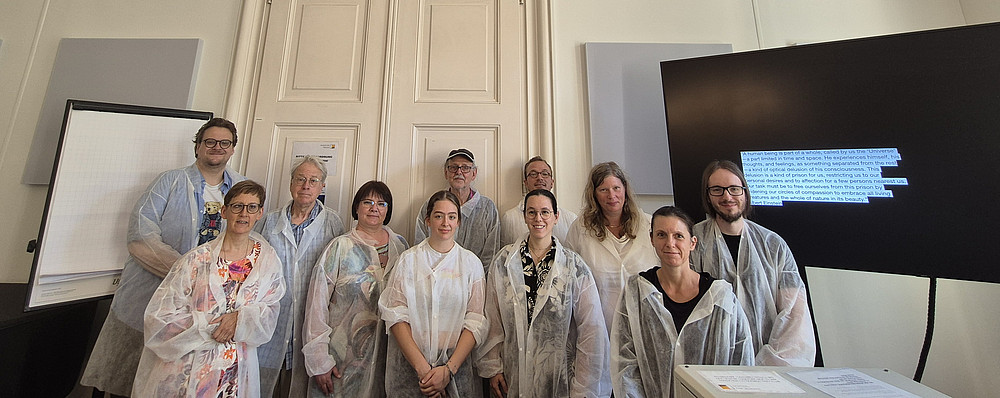
Hannes Priesch is an artist living in Semriach, Austria. He studied at the Academy of Fine Arts in Vienna from 1973 to 1977 and is a founding member of the REM artists’ group in Vienna, as well as the founder of OM THEM, a public art platform in New York City. Priesch lived in the USA from 1990 to 2016. His art, which encompasses multimedia, installation art, painting and drawing, amongst other forms, has been featured in numerous exhibitions (including the Kunsthaus Graz, the Neue Galerie Graz and the Museum Liaunig Neuhaus). In his performance-lecture, drawing on a quote from Albert Einstein, Priesch explored the paradox of separation and connectedness as it manifests in human culture, theory, art and politics. We find ourselves in an era of unusual and extreme trends that are currently vying to shape our future. Using examples from the intersection of anthropology, fiction, non-fiction and science fiction, connections were drawn to earlier art movements, in particular Futurism – possible precursors to current developments – whose roots often lie within a broader ideological framework, such as Marinetti’s 1909 Futurist Manifesto or contemporary projects, such as the establishment of a ‘Manhattan Project of our time’, dedicated to the development of cutting-edge technologies in a deregulated environment (Alameda Point near San Francisco). The well-attended lectures by Barbara Mielcarek-Krzyżanowska and Hannes Priesch were followed by lively discussions.